
Welcome all to the blog series “Finance For Everyone”. Many people are keen on starting their stock market investment journey. But they are unsure how and when to start. The stock market is sometimes in a bullish phase and sometimes in a bearish phase. People are suspicious about the returns in the stock market. They fear losing all their money. Choosing the best investment time in the stock market is difficult. The best time to invest in the stock market is when you are accustomed to the stock market environment.
- ‘What is ‘Nifty 50’ and ‘Sensex’
- Difference between Nifty 50 and Sensex.
- How the Nifty 50 or Sensex is calculated
- Nifty 50 and Sensex Returns
Nifty 50 Index :-
This Indian stock market index represents the 50 largest Indian companies listed on the National Stock Exchange as per their free-float market capitalization. The full form of NIFTY is the National Stock Exchange Fifty.
The Nifty 50 index was launched on 22nd April 1996. The base value of the index has been set at 1000. Now, as of Feb. 2025, Nifty 50 is trading at about 23,581.15. This index will give you an overall mood of the stock market, whether the market is moving up or down. NSE has more than 1,600 listed companies.
SENSEX:-
The Sensex represents the 30 largest Indian companies listed on the BSE (Bombay Stock Exchange) as per their free-float market capitalization. It was started on 2nd Jan 1986 with a base value of 100. As of today March 2026, Sensex is trading at about 76,070. Since the Sensex represents only 30 companies in the Market, it is more concentrated than the Nifty 50. The full form of SENSEX is the Stock Exchange Sensitive Index. BSE has more than 4,000 listed companies.
How the Nifty 50 / Sensex is calculated
The companies in the Nifty 50 and the Sensex keep changing based on their performance. Top-performing companies become part of the Nifty 50 and the Sensex. Underperforming companies go out. You can judge the general sentiments of the market by following these indices. You can compare your investment (mutual fund or share) with these indexes to judge their performance.
While starting the investment journey, we should know about the historical returns given by these indexes. This will give you an idea about the minimum returns one should expect from our investment. Our investment return should at least beat nifty or Sensex return.
The performance of the Nifty 50 or Sensex does not always give you the correct picture of the whole market. Sometimes it may happen that the Nifty 50 or Sensex is moving up, but your investment portfolio is not performing. This is happening because Nifty 50 and Sensex represent only the Top 50/30 companies, whereas your portfolio companies may not be part of the list.
By following these indexes you can guess the general market mood. Generally, the market moves in phases. In the Bull phase, indexes move up daily, and in the Bear phase, it goes down. You can decide on your investment strategy by following these indexes. Sometimes the market moves sideways. In this phase, it does not give any clear trends of up or down. You should be careful while investing in this phase.
Nifty 50 vs Sensex returns
Nifty 50 and Sensex almost give the same returns in the Long run. Portfolios of both overlap substantially. The stock portfolios of Nifty 50 and Sensex are 85 % (Approx.) identical.
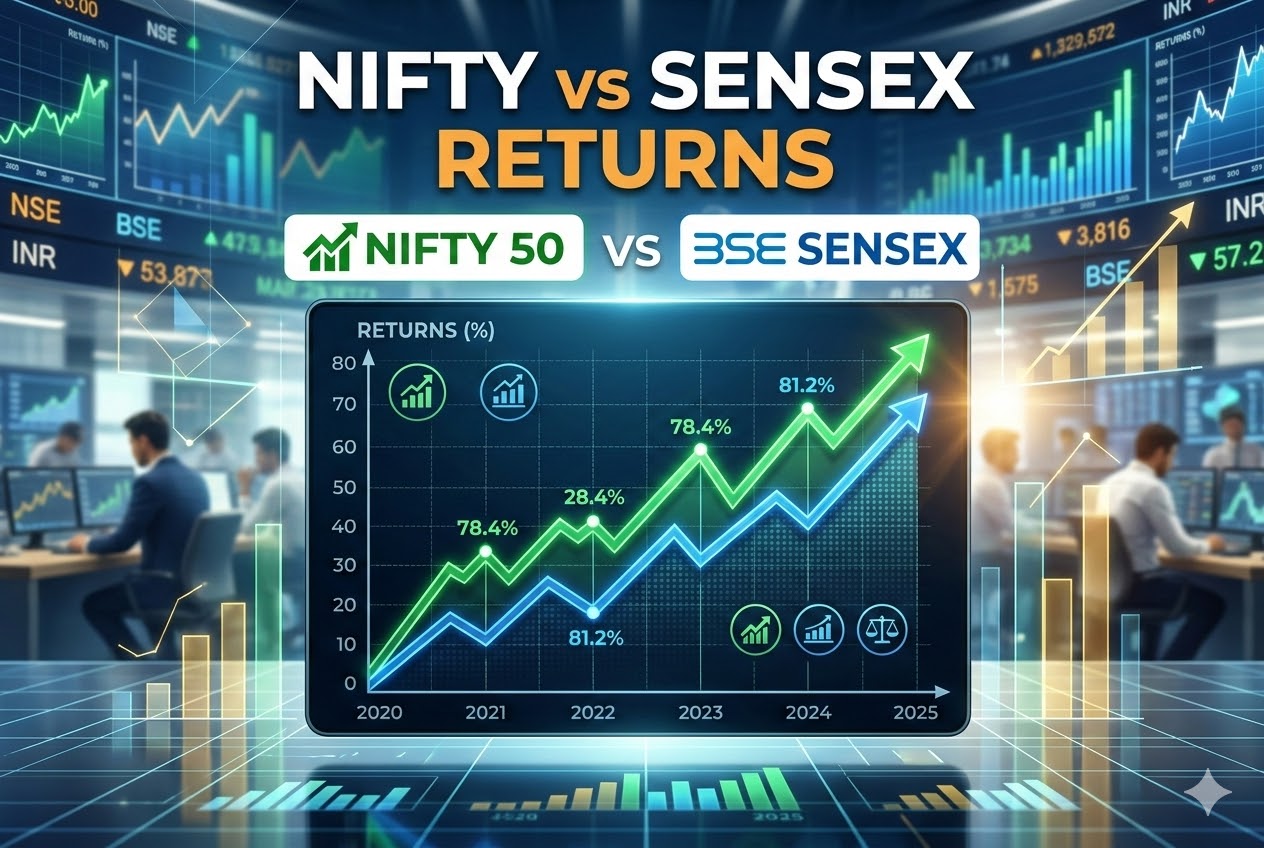
Returns of Nifty 50 and Sensex for the last 5 Years ( From 2021 to 2025 ) (~ means approximately)
|
Year |
Nifty 50 Return |
Sensex return |
|
2021 |
24.10 |
22.00 |
|
2022 |
4.30 |
4.4 |
|
2023 |
20.00 |
18.70 |
|
2024 |
16.00 |
15.50 |
|
2025 |
10.12 |
10.11 |
CAGR Returns of Nifty 50 vs Sensex as on Dec. 25
| CAGR Returns | Nifty 50 | Sensex |
| 1 Year (2024-2025) | ~10.5% | ~10.0% |
| 5 Years (2021-2025) | ~15.2% | ~14.8% |
| 10 Years (2016-2025) | ~12.6% | ~12.3% |
The Bestway to invest in Nifty 50 or Sensex is to use any index mutual fund that follows Nifty 50 or Sensex.
Some of the Top Nifty 50 Index Fund
UTI Nifty 50 Index Fund, HDFC Nifty 50 Index Fund, ICICI Prudential Nifty 50 Index Fund
Some of the Top Sensex Index Funds
HDFC BSE Sensex Index Fund, ICICI BSE Sensex Index Fund, SBI BSE Sensex Index Fund
Nifty 50 vs Sensex return explained in detail video
Frequently ask Questions
Before investing in the market, investors should follow the trends of the Nifty 50 and the Sensex, which will give them an idea of the stock market’s performance.
What is Nifty 50 Index ?
Nifty 50 index represents the top 50 companies of NSE.
What is the full form of Nifty 50?
National Stock Exchange FIFTY.
What is Sensex?
This index represents the top 30 companies of the BSE.
What us full form of SENSEX? :
Stock Exchange Sensitive Index.
What is the Market Capitalization of the Company? :-
Total market value of all outstanding company shares.
Formula — No of outstanding shares of the company ( X ) Price per share.
What is meant by Free-float market capitalization? :
Means the Company’s total Market Capital minus the Capital owned by the Owner/institution/Government. Free-float market capitalization is capital that is freely traded on the Stock Exchange. It is that capital which is available for trading to the public.
What is returns of Nifty 50 vs Sensex :
Returns of Nifty 50 and Sensex are almost the same in the long run. The average CAGR return of Nifty 50 and Sensex is 12% to 14% Approx.
The reader will also like to read about the following topics
3. Nifty 50 vs Nifty Next 50 vs Nifty 100
4. Large Cap vs Mid Cap vs Small Cap
5 . Value investing vs Growth Investing
6. What is a Mutual Fund and SIP
8. Absolute Return / CAGR / XIRR
9. Difference Between NSE and BSE
Nice blog